
Approaches for Supporting Personalized Needs of Learners
There are many ways to support the personalized needs of all learners in your classroom, school, or district. While approaches, as listed below, range in degree to impact personalized needs, being data-informed and deliberate in our analysis of students’ individual needs leads to impactful learning experiences — and can be anticipated.
This is why Intentional Differentiated Instruction is essential. When implemented in a planful way with student intent in mind, it serves as an effective engine for elevating every major personalization framework in K-12 education today.
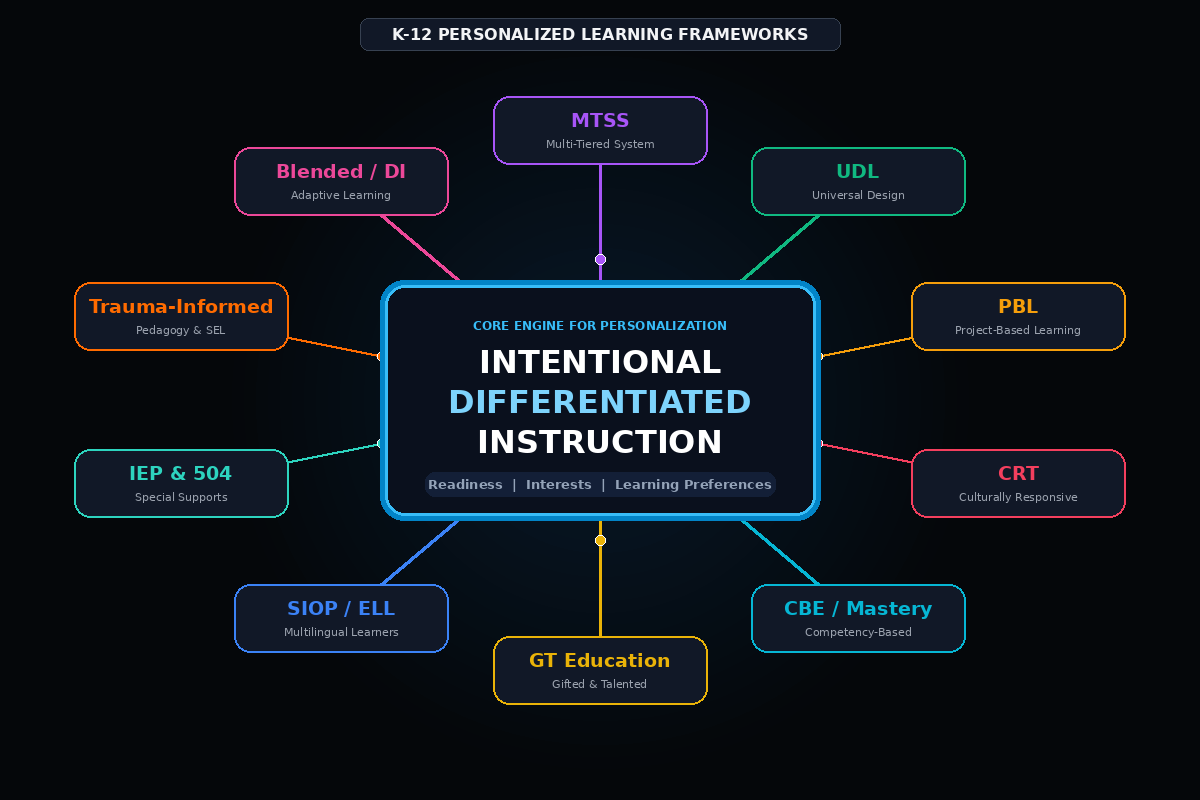
Intentional Differentiated Instruction: The Engine of Personalization
Intentional Differentiated Instruction is a framework for incorporating supports that strategically aid all learners to achieve — ranging from advanced learners continuing their upward trajectory to students closing achievement gaps to progress.
Keeping the End in Mind, teachers review and revise lessons based on the content to learn, the processes of the lesson layout, and the products that provide data points for further adaptations and adjustments. Teachers intentionally differentiate instruction based on student data regarding their Readiness, Interests, and Learning Preferences.
Core Articles & Planning Resources:
Quick View: 12 Frameworks for Personalizing Learning
Intentional Differentiated Instruction serves as the core engine for elevating each of the following 12 personalized learning approaches:
Differentiated Instruction (DI)
Multi-Tiered System of Support (MTSS)
Adaptive / Blended Learning
Competency-Based Education (CBE)
Culturally Responsive Teaching (CRT)
Gifted and Talented (GT) Education
Project-Based Learning (PBL)
Section 504 Plans
Sheltered Instruction (SIOP)
Special Education (IEPs)
Trauma-Informed Pedagogy
Universal Design for Learning (UDL)
Full Framework Descriptions & Resource Guides
1. Differentiated Instruction (DI)
A framework for modifying instruction by adapting content, process, product, or learning environment. Teachers tailor these elements in response to a student’s individual readiness level, interests, and learning preferences to maximize personal growth and academic success.
- Article: A Manageable Strategy for Impactful Differentiation
- Article Collection: Differentiated Instruction Resources
- Opening Paths Hub: Intentional Differentiated Instruction Resources
2. Multi-Tiered System of Supports (MTSS)
A systemic, data-driven framework that provides layered tiers of academic and behavioral interventions. It ensures all students receive high-quality core instruction (Tier 1), while seamlessly identifying and providing targeted support (Tier 2) or intensive, individualized interventions (Tier 3) based on real-time student needs.
3. Adaptive / Blended Learning
Uses software algorithms to continuously analyze student performance data in real time, dynamically adjusting the path, difficulty, and pacing of practice tasks to match the precise skill frontier of each learner.
- Article: Implementing Blended Learning in Upper Elementary Writing Lessons
- Article Collection: Self-Paced Blended Learning: A Resource Roundup
4. Competency-Based Education (CBE) / Mastery-Based Learning
Replaces traditional time-based progression with skill mastery. Students advance through learning targets at their own individual pace as soon as they demonstrate proficiency, rather than following a fixed class schedule or seat-time requirement.
5. Culturally Responsive Teaching (CRT)
Personalizes instruction by anchoring content to students’ cultural backgrounds, lived experiences, and home languages. It leverages students’ cultural frames of reference as cognitive scaffolds to make rigorous academic content more accessible and engaging.
6. Gifted and Talented (GT) Education
Specialized programming and instructional strategies designed for students who demonstrate outstanding levels of aptitude or competence. It personalizes learning through curriculum compacting, acceleration (moving through material faster), and enrichment (exploring concepts in greater depth and complexity).

7. Project-Based Learning (PBL) with Voice and Choice
A structural framework where students demonstrate standards mastery through extended real-world projects. Personalization occurs through student agency—learners select their own inquiry focus, research methods, and final presentation formats based on individual interests and strengths.
- Article Collection: Project-Based Learning Resources
- Resource Guide: Resource Guide: Project-Based Learning (PBL)
8. Section 504 Plans
Provides legally mandated environmental and academic accommodations (such as modified testing environments, frequent breaks, or assistive technology) for students with physical, mental, or medical conditions that impact major life activities, without altering the core curriculum as Special Education does.
- Article: Supporting All Students With Special Needs
- Article: 504 Plans: A Guide for Teachers
9. Sheltered Instruction Observation Protocol (SIOP)
A research-based model for lesson planning and delivery specifically designed for Multilingual / English Language Learners (ELLs). It personalizes learning by intertwining grade-level academic content with explicit language acquisition support, ensuring rigorous content remains comprehensible.
10. Special Education (IEPs)
Specially designed, legally mandated instruction to meet the unique needs of a child with a qualifying disability. This involves creating an Individualized Education Program (IEP) that outlines specific academic or behavioral goals, tailored modifications to the curriculum, and specialized related services.
11. Trauma-Informed Pedagogy
Adapts classroom environments, discipline strategies, and instructional delivery to support learners impacted by adverse childhood experiences or toxic stress. It focuses on individual emotional regulation, psychological safety, and predictable routines.
12. Universal Design for Learning (UDL)
A proactive design framework aimed at removing barriers to learning before they occur. It builds flexibility into the curriculum from the start by providing multiple means of engagement (the “why”), representation (the “what”), and action and expression (the “how”), anticipating the diverse needs of all learners.
Bring Intentional Differentiated Instruction to Your School or District
Intentional Differentiated Instruction turns disparate frameworks into a cohesive, sustainable daily teaching practice. Whether you are seeking staff-wide professional development workshops, administrative coaching, or self-paced online courses, Opening Paths provides practical strategies built for immediate classroom impact.