Differentiation is often framed as a classroom strategy. In reality, it is a schoolwide challenge.
If we expect teachers to meet the needs of every learner, we must also rethink how we support every teacher. What does it take for professional development (PD) to truly change practice—not just inspire it? What makes learning “stick”? And what would it look like for a professional learning community (PLC) to emerge not by mandate, but through shared purpose and genuine engagement?
At Tsinglan School, an internationalized K–12 school in southern China, we explored these questions through a simple but ambitious move: we made differentiation the focus of an entire year of professional learning. What followed was not just improved instructional practice, but the emergence of a new teacher training model—and a schoolwide PLC grounded in collaboration, inquiry, and shared ownership.
Start with a Shared Focus
Differentiation is not new. Most teachers have heard of Carol Ann Tomlinson’s framework—differentiating content, process, and product based on students’ readiness, interests, and learning profiles. Yet familiarity does not equal mastery.
In today’s world, students arrive in classrooms with vastly different prior knowledge, shaped by constant access to information beyond school. Teaching, therefore, must shift—from delivering knowledge to developing learners. Differentiation is no longer optional; it is essential.
Because the concept was already familiar, we chose differentiation as our first-ever yearlong PD theme. This decision proved critical. Instead of fragmented workshops, teachers engaged in a sustained, coherent learning journey. Each session built on the last. Understanding deepened over time.
But we also knew that a theme alone is not enough. It needs structure, coherence, and a way to connect theory to practice.
Build a System, Not a Series of Workshops
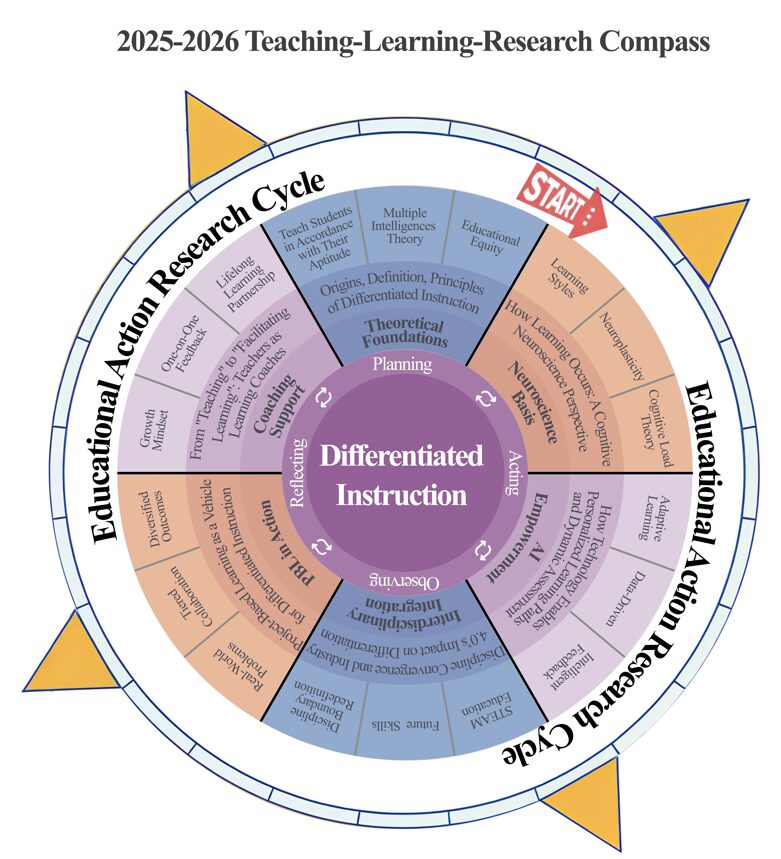
To guide this work, my team and I in the Curriculum, Teaching, and Assessment Center, developed what we called the “Differentiation Compass”—a “six-dimensional, one-system” model.
Rather than treating differentiation as a set of isolated strategies, the Compass integrates six interconnected dimensions:
- Foundational theories
From Confucian “teaching according to individual aptitude” to Vygotsky and Gardner - Insights from cognitive science
- The role of technology and AI
- Interdisciplinary curriculum design
- Project-based learning (PBL)
- Instructional coaching
Each dimension serves a purpose. Together, they form an ecosystem.
Philosophy provides direction. Brain science offers evidence. Technology expands possibilities. Curriculum carries learning. Instruction enacts it. Teacher development sustains it.
This shift—from strategy to system—was essential. It helped teachers see differentiation not as an add-on, but as a way of thinking about teaching itself.
Make Teachers Active Designers of Learning
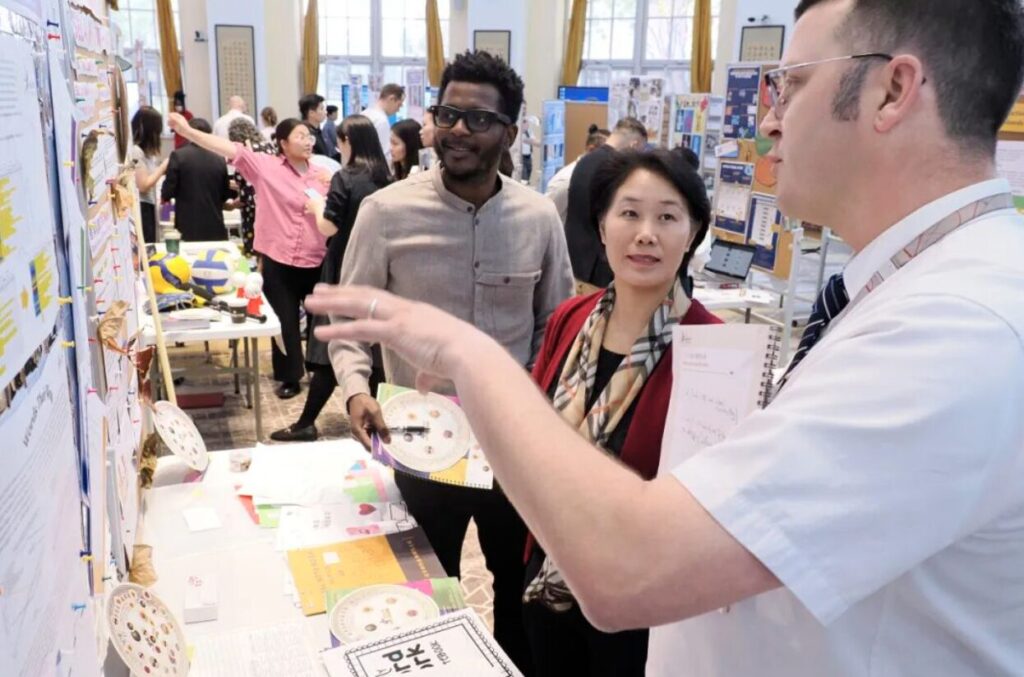
Professional learning changes when teachers stop being passive recipients. To bring the Compass to life, we designed a culminating schoolwide project: the “Differentiation Fair”. Every teacher, working in teams, was asked to demonstrate how they understood and applied differentiation in practice. They could present their lesson designs and student work through workshops, videos, or poster boards.
This was not a showcase at the end. It was the engine of learning.
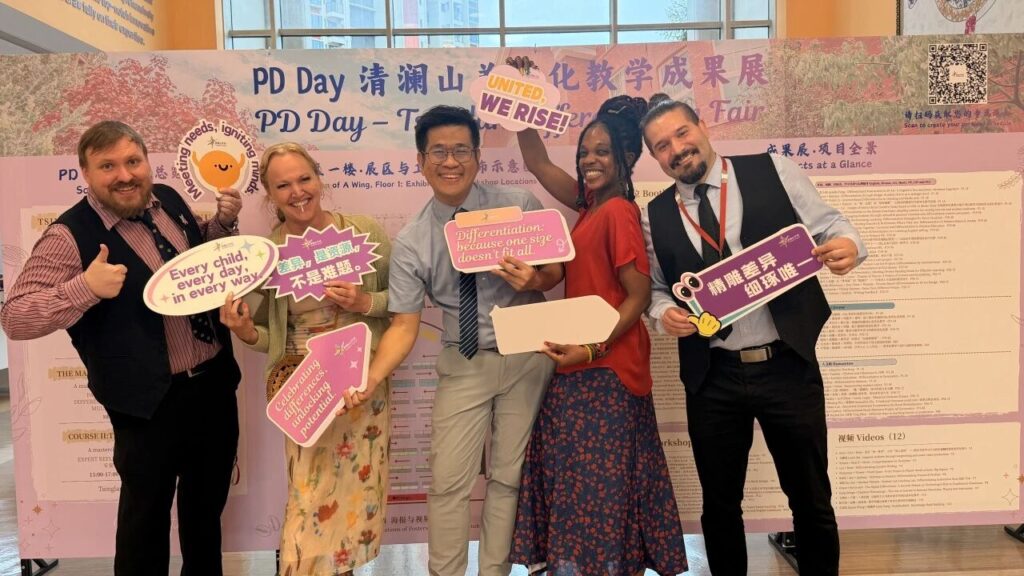
Teachers collaborated across departments. They tested ideas in classrooms. They refined their approaches. They returned to their teams to reflect and improve. During this process, I regularly checked in with different teacher groups, while some also proactively sought feedback and suggestions. I was able to share strong examples from teams that were progressing more quickly, which helped provide direction and inspiration for others. To make the workload more manageable, we established staggered deadlines that broke the project into smaller, achievable tasks, including deadlines for submitting the project title, project introduction, poster boards, and presentation slides. We also provided materials that teachers might need so they would not have to spend additional time or resources looking for them independently.
At the same time, division directors and department heads worked closely together to support and monitor progress throughout the planning phase for the “Differentiation Fair”. The exploration lasted four months of the school year. Teachers received guidance during multiple preparation blocks and were also held accountable within their respective departments, creating a balance of support, structure, and shared responsibility throughout the process.
This process closely aligns with the core ideas of PLCs as described by Richard DuFour:
- Shared focus on student learning
- Collaborative work
- Ongoing cycles of inquiry
But here’s the difference: the PLC was not introduced as a structure. It emerged through the work itself.
Close the Loop: From Learning to Practice and Back
One of the most important shifts we made was moving from “event-based PD” to a closed-loop system.
Traditionally, PD is fragmented. A workshop happens. Teachers return to their classrooms. The connection fades.
We designed a different cycle:
Conceptual input → Classroom implementation → Public demonstration → Reflection and refinement
The Differentiation Fair served as the culminating moment in this cycle. It gave teachers a clear goal. It also gave them ownership.
To deepen the experience, we invited external experts as “critical friends.” Their role was not to evaluate, but to engage in dialogues. This reduced pressure and increased openness. Feedback became something teachers sought out—not something they endured.
At the same time, internal expertise became central. Department heads and division leaders were trained first, then led ongoing discussions within their teams. Real classroom cases became the core of PD. Theory met practice—daily, not occasionally.
The result was coherence. Teachers were not attending PD. They were living it.
From PD to PLC: A Cultural Shift
By the end of the year, the most significant outcome was not any single strategy. It was a shift in culture.
A PLC had taken shape—organically, and at scale.
First, there was a shared language. Differentiation became a common reference point across the school. Teachers discussed readiness, pathways, and student variability with clarity and confidence.
Second, collaboration became routine. Team-based preparation, cross-disciplinary dialogue, and structured meeting times created space for sustained interaction. Collaboration was no longer an expectation—it was a habit.
Third, the focus remained on learning, not performance. The Differentiation Fair had no rankings or prizes. Instead, it created opportunities for observation, feedback, and idea exchange. Teachers learned from one another, not for recognition, but for growth.
Finally, inquiry became continuous. After the Fair, teachers reflected, revised, and in many cases, documented their work for our annual research conference. Practice did not end with presentation. It evolved.
One teacher captured this shift succinctly:
“We always talk about building a teacher community. This was the first time I truly felt it.”
What Changed—and Why It Matters
At the end of the year, three things were clear.
- We had built a shared understanding of differentiation.
- We had developed a coherent, system-level PD model.
- And we had fostered a schoolwide PLC grounded in real work.
These are not separate outcomes. They are interconnected.
- A strong PD theme provides direction.
- A coherent PD system provides structure.
- A PLC provides sustainability.
Together, they create the conditions for lasting improvement.
Differentiation, in this case, was both the driver and the result. It improved classroom practice. But more importantly, it reshaped how teachers learn, collaborate, and grow.
Moving Forward
In complex and rapidly changing educational environments, isolated strategies are no longer enough. Schools need coherence. They need systems. And they need a culture that supports continuous learning.
Our experience suggests that when professional development is sustained, structured, and rooted in authentic practice, it can do more than improve instruction. It can transform how a school learns.
And when that happens, differentiation is no longer just something teachers do.
It becomes part of who they are.
Meng Li Author Profile
Meng Li is an educator in China. She leads the curriculum team at Tsinglan School, a high performing international K-12 school. Previously she taught at Riverdale Country School in New York City.